
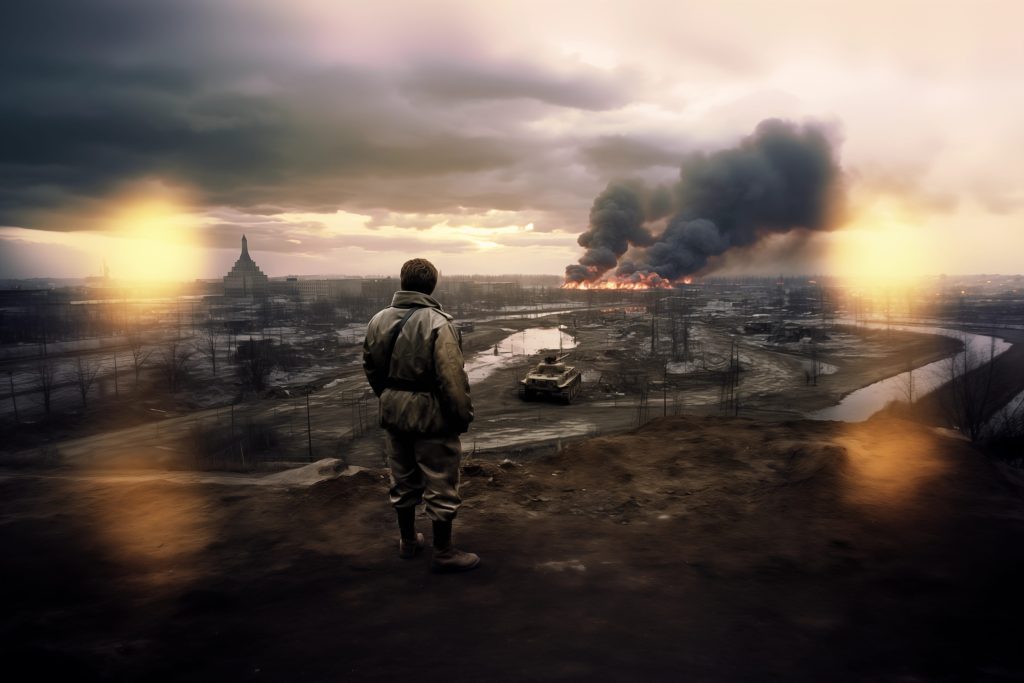
How did this happen?
My bare-bones history of how the hell this happened. Note that this is specific to my version of the world, not every author would agree.
The War
The Sino-American War (often referred to in the US as “The Chinese War,” or sometimes by the name of its precipitant, “The Iran War”) was a devastating conflict that ultimately ended in a bloody stalemate for all sides.
In the aftermath of an exhausting fight between the United States and the Islamic Republic of Iran over the Straits of Hormuz, the US quickly became embroiled in a dispute between the Republic of Taiwan and its larger neighbor (and claimed ruler), the People’s Republic of China. The dispute escalated into fighting, and the fighting into a limited nuclear strike by both powers. Immediately following the strikes on a PLA invasion fleet in the Taiwan Strait and on the US airbase on Guam, cooler heads prevailed and an armistice was reached.
While the damage from the nuclear weapons was limited to Asia and Oceania, the effects of bioweapons unleashed early on in the conflict would be felt world-wide and continue for generations. The most notorious toxin was the AN236 virus, popularly known as the Androvirus or “Widowmaker” for its targeting of humans carrying a Y chromosome.
The virus was eventually contained but not before killing large numbers of men. The resulting gender imbalance was officially estimated to be at least four females for every three males, and much higher in some hard-hit places.
Domestic Response
The battered US faced a number of problems: protect the barely-recovering economy, provide for the numerous widows and orphans of the virus, ensure stability in postwar society, and retain the social standing of now-minority males.
One “solution” promoted by conservative, big business and right-wing religious groups was a return to a form of slavery, based not on race but on one’s sex. Advocates assured political leaders that the majority of those affected would be racial and economic minorities. White women of at least middle class standing would be untouched.
Business groups pushed hardest due in large part to government efforts and monetary incentives to “Reindustrialize” the country. Workers who could not quit, could not unionize, could not refuse tasks and worked for (effectively) minimal food and shelter were ideal. Large numbers of workers would require specialized training in industrial skills, and slaves could not leave for better jobs immediately after training concluded.
The business interests plans were unexpectedly derailed by their allies the Christian Right, who wanted to both curtail the power of women and increase birth rates among white Christians through multi-female homes. They, along with conservative “Men’s Rights” proponents, pushed for the initial limitation of indenture to females.
Thus the ruling “Victory & Prosperity” party passed the Indenture Act. Any female over the age of eighteen convicted of a felony, homeless for ninety days, requiring public intervention for alcohol or drug addiction, or who volunteered (typically in exchange for some consideration such as money or an education) could be temporarily stripped of their citizenship rights and converted to an indentured servant for a period of no less than 90 days nor more than 10 years.
The law was fiercely contested, starting with legal challenges heard by the Supreme Court. The business-owned conservative majority held the law to be constitutional due to it not contradicting the 13th Amendment, which outlaws slavery “except as a punishment for crime.”
Intended to promote stability, the law instead created mass unrest which increasingly led to violence. One year later, in response to an especially deadly protest-turned-riot that killed a number of federal police officers, the ruling party doubled down on repression by passing the Universal Indenture Act.
The new law extended the maximum possible term of indenture to the life of the person (but only for violent crimes, and not debt, addiction or homelessness), expanded indenture to apply to males, made it illegal to assist any person evading or escaping indenture, and made interfering with any institution or person conducting indenture activities (e.g. slave markets, slave catchers, police) a felony.
While the Universal Indenture Act did reduce public unrest due to harsh penalties and strict enforcement, the violent opposition moved underground. The smallest, best-known, and most dangerous of the violent resistance groups is the John Brown Society (a.k.a. The JBS), known for bombings, assassinations, and media-friendly raids on slaving companies.
Not all resistance was violent. Many Americans fled abroad where slavery was still illegal. This diaspora is often credited with the origin of the Underground Airline. Sometimes known as Air Venezuela or Air China, it is a large decentralized network of activists and sympathizers that models itself after the nineteenth-century Underground Railroad. Like the original organization, members are committed to assisting slaves escape abroad, originally to Latin America.
Eventually the ruling party, failing to enact any of their economic goals, was thrown out of office, replaced by the centrist “Democratic Republican Party.” Reform of the indenture system was a core promise of the party after years of well-publicized abuses and scandals, resulting in the Indentured Service Reform Act. The act outlawed the most egregious abuses (such as murder, maiming and disfigurement), mandated minimum standards of care for slaves, creating what was known collectively as the “Slave Codes,” a set of federal laws and regulations governing enslavement and the treatment of slaves. The US Department of Involuntary Service (USDIS) was created to enforce the codes, and though small in number their agents have a great deal of power when investigating slave owners and institutions.
The “Slave Codes” superseded the patchwork of state laws and making slave handling more consistent across the country. But remembering the near-secession of several states (starting with California) near the end of the Sino-American War, the US government decided to grant states a great deal of leeway with regard to how slaves are regulated. So it is not unusual for slavery to be regulated in one fashion in a particular state, and regulated in a very different manner right next door in another state. For example, Texas prefers to regulate slaves as livestock, using animal terminology and livestock ranching agencies to oversee sales, while neighboring New Mexico prefers to regulate slaves under their Department of Health and tracks slaves by name more than number. The states are also the primary enforcers of the Codes, due to the small size of the USDIS. In Texas, for example, routine inspection and regulation of slave markets and related businesses is performed by livestock agents of the Texas Animal Health Commission, and investigations of individual cases are handled by the Department of Public Safety in general and the Texas Rangers specifically.
Present Day
Much of the violence of the early days of legalization has faded away, aside from an occasional attack by an abolitionist group. As the economy slowly recovers, society seems to have made an uneasy peace with the “peculiar institution.” Wether and how long that will last is anyone’s guess. More about the status quo in the next article.